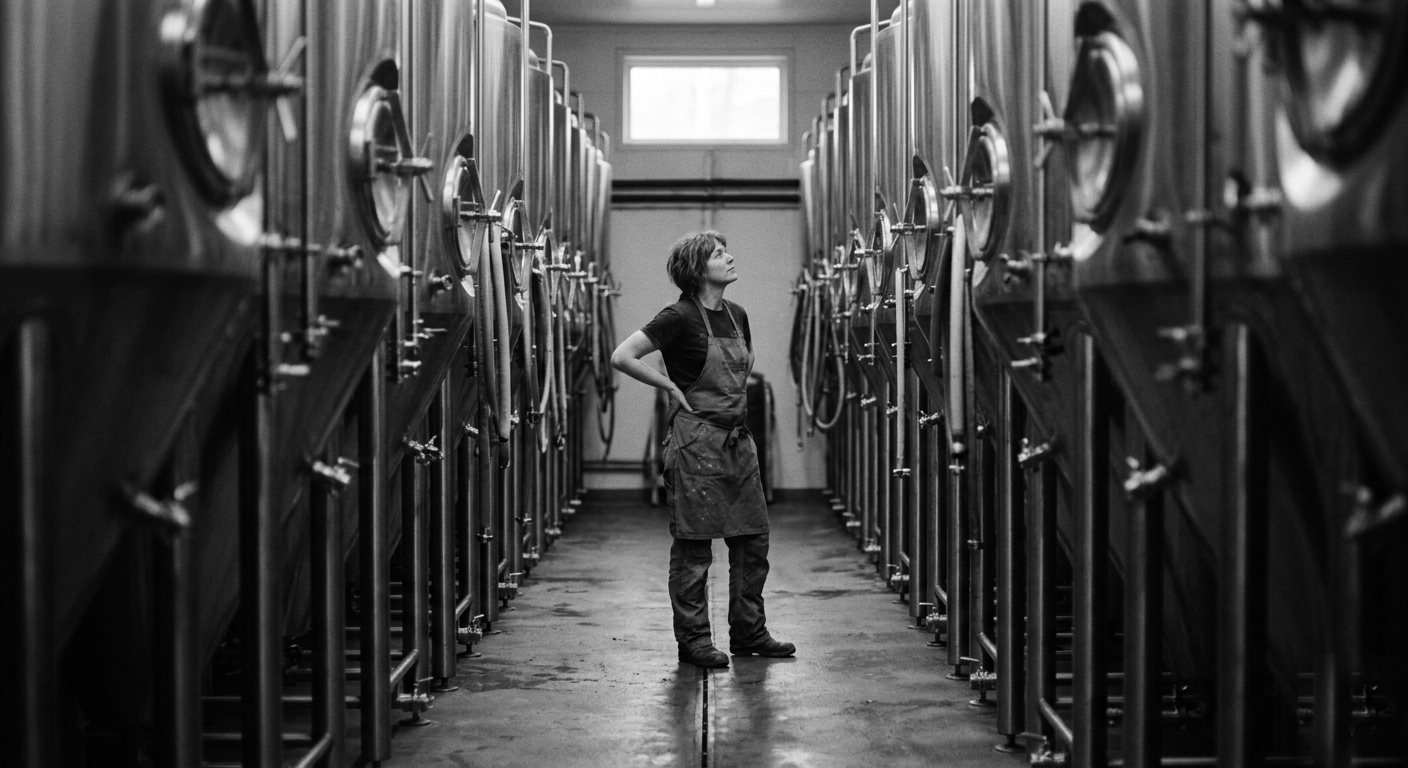
Every brewery lives this, and most brewers quietly believe it's their own fault. It isn't. It's arithmetic.
It starts somewhere around the middle of October. A distributor asks whether you can cover December. The taproom manager mentions that last year you ran out of the dark beer before the fifteenth. Somebody wants a collaboration brewed in time for a festival. And you look at the fermenters, and you already know.
You brew flat out for six weeks. You short somebody. You pull the lager a week early and hope nobody tastes the diacetyl — or the green apple, or the sulfur. And you tell yourself that next year you will plan properly.
Next year, the same thing happens.
Here is the arithmetic nobody does out loud. From the moment you decide to brew a beer to the moment somebody can drink it: three or four weeks for a straightforward ale, two to three months for a lager that has been given its time. That counts the whole loop — waiting for a free fermenter, the brew day, tank time, packaging, and getting it out the door.
You can push an ale a few days. Push a lager and everyone who drinks it knows.
Demand doesn't work on that clock. Demand becomes obvious in October, because that's when people start asking about December.
So by the time the need is visible, the beer that would have met it needed to be in a tank weeks ago. The decision point has already passed, silently, while everything looked fine.
That's the whole problem. It's not laziness, it's not disorganization, and no amount of trying harder closes a gap that exists in the calendar rather than in anyone's character. The lead time beats the intuition, every time.
Most breweries are planning on a whiteboard, a shared spreadsheet, or the memory of whoever has been there longest. All three are honest tools and all three have the same blind spot: they only know what somebody remembered to tell them.
A spreadsheet doesn't know a batch slipped. Somebody has to notice, and then re-key it, and then redo the arithmetic by hand. Which is why the wall calendar is usually wrong by Wednesday.
It also doesn't know your real numbers. It knows the fourteen days somebody typed into it two years ago — not the seventeen your pale ale actually takes, in your tanks, with your yeast. Your own history is the most useful data any brewery owns, and almost nobody has it in a form that can be added up.
And the honest one: a spreadsheet could tell you in August that December is impossible. It could. But somebody would have to sit down and work it out, and nobody ever does, because in August nothing is on fire.
Not a more detailed plan. A more detailed plan is worse.
Draw a precise schedule for November in August and people will plan against it. Then three batches slip, a tank goes down, a collaboration appears, and every date on it's wrong — but it looked authoritative the entire time. A chart that says about full rarely misleads anyone. A schedule with a wrong date on it does.
What helps is seeing far enough ahead at the right resolution. Months out, you want load — how much brewhouse, how many fermenter-days, how many line-hours the orders you've already promised will eat, against what your brewery can actually produce. Close in, inside the horizon where decisions are real, you want a schedule.
Load tells you in August that December doesn't fit. The schedule tells you what to do on Tuesday. Confusing the two is how breweries end up with a beautiful plan and a scramble anyway.
There's an obvious thing to build here, and we have deliberately not built it.
We don't forecast demand. No software can tell you how much beer your market will want in December, and the ones that claim to are inventing a number and then handing you a plan that inherits its wrongness while looking authoritative. A forecast is a number a system made up. A commitment is a number a person made. A measurement is what actually happened.
Work from the last two and the plan can be wrong, but only in ways you can see.
None of this stops November being busy. It stops November being a surprise, which is a smaller thing, and the only one on offer.
This is the first piece in the journal. We publish when there's something worth saying — roughly every other week, not on a schedule we're trying to feed.