We're choosing twelve breweries to run BrewOS alongside us from the start. Small, watched closely, and we'll write down honestly how it went.
Applications close 30 November
I built the first version for one brewery. Mine. It is better than it was because that brewery kept finding things wrong with it.
One brewery's problems only get you so far, though. The next year of this needs the awkward cases — the thing that annoys you in week three, the way your cellar runs that I'd never have thought to try, the sentence on a screen that means something different in your brewery than it does in mine.
So we sit down four times in the first year, and not on a calendar — at the four points where there's actually something worth looking at.
They're working sessions about your production, with a brewmaster — not support calls about software. What we get out of them is finding out what BrewOS got wrong while you still remember being annoyed by it.
You wouldn't be testing it. You'd be shaping it.
That's the arrangement. There's no contract longer than this page.
Setting a brewery up properly is real work — your tanks, your recipes, your units, your language, all set up the way you actually brew. We do every one of them by hand, and twelve is as many as we can do that way in a year.
Once twelve are in, we stop taking applications and get on with the work. We'll open again when we can give the next ones the same attention.
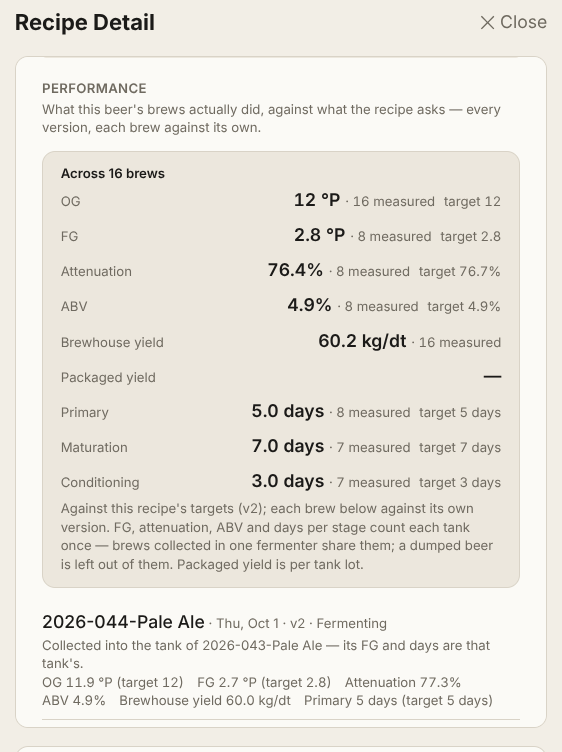
After enough batches, every recipe shows what its brews actually did against it: gravity, attenuation, yield and the days each stage took. That’s where the conversation gets useful, and it’s why the sessions follow the brewery, not the calendar.
Tell us what you brew, how many tanks you've got, how often the brewhouse runs, and what you're using to keep track of it today. A paragraph is plenty. If a spreadsheet's still doing the job, we'll say so.
Write to [email protected]
We set up every brewery by hand. There's no signup button.